Brigham Young University - Idaho
Location: Rexburg, Idaho
Owner: Brigham Young University - Idaho
Landscape Architect: D.A. Hogan
Completed: September 2006
Many unique challenges existed on this project. FIELDS scheduled around ongoing college intramural events. The project was built simultaneously from one end of the campus to the other, spanning a distance of several miles so that the tight schedule could be met.
The project was awarded on May 10, 2006, for an immediate construction start with an intended completion date of September 30, 2006. FIELDS was selected in part because of our ability to assemble a team that could work expeditiously and with very limited oversight.
Stadium Renovation
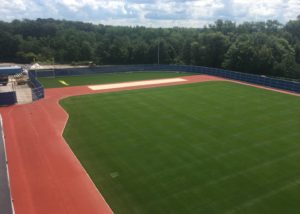
We removed existing curb around the track, saw cut the track edge, and installed 1,400 linear feet of new curb with a 6-inch-wide, pre-manufactured trench drain in it. During the field demolition, we encountered poor soils when excavating for the sub-base, which required us to stabilize the soil to get the specified compaction.
We installed a new storm drain loop with eight drainage structures. The field drainage system was comprised of a herring-bone pattern layout of 12-inch-wide flat drain placed on top of geotextile fabric. The drainage layer was made up of 8 inches of compacted crushed stone that drained at a rate of 20 inches per hour. New running lanes and jump pits for the long jump and triple jump were built. A new high jump area was constructed with a synthetic rubber surface overlay on it. The final elements included a shotput circle, pit, and discus cage.
Baseball Field
We installed eight 80-foot Musco light poles on the field and installed all the necessary electrical components for them to operate efficiently, including new transformers and a computerized control panel.
We reconfigured the fencing layout inclusive of rebuilding the bullpens and installed ball control fencing. Also installed was a new 200-foot concrete retaining wall along the first base line to handle the transition in grade. All of this construction was done inside of a temporary fence so that a full intramural baseball schedule could continue to be played on a reduced-size field.
Soccer Fields
The work on these fields required the removal of 48 light poles and their footings and replacing them with 32, 70-foot Musco light poles and footings. Because we were working on a filled area and the soil reports showed limited bearing capacity, we were required to drill shafts for each light pole.
The shaft depths ranged from 16 feet to 35 feet in order to get enough lateral support in the soil. We were also responsible for putting up a temporary fence to allow for continued play on the fields during construction.
New Complex
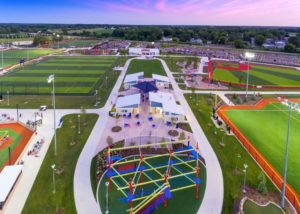
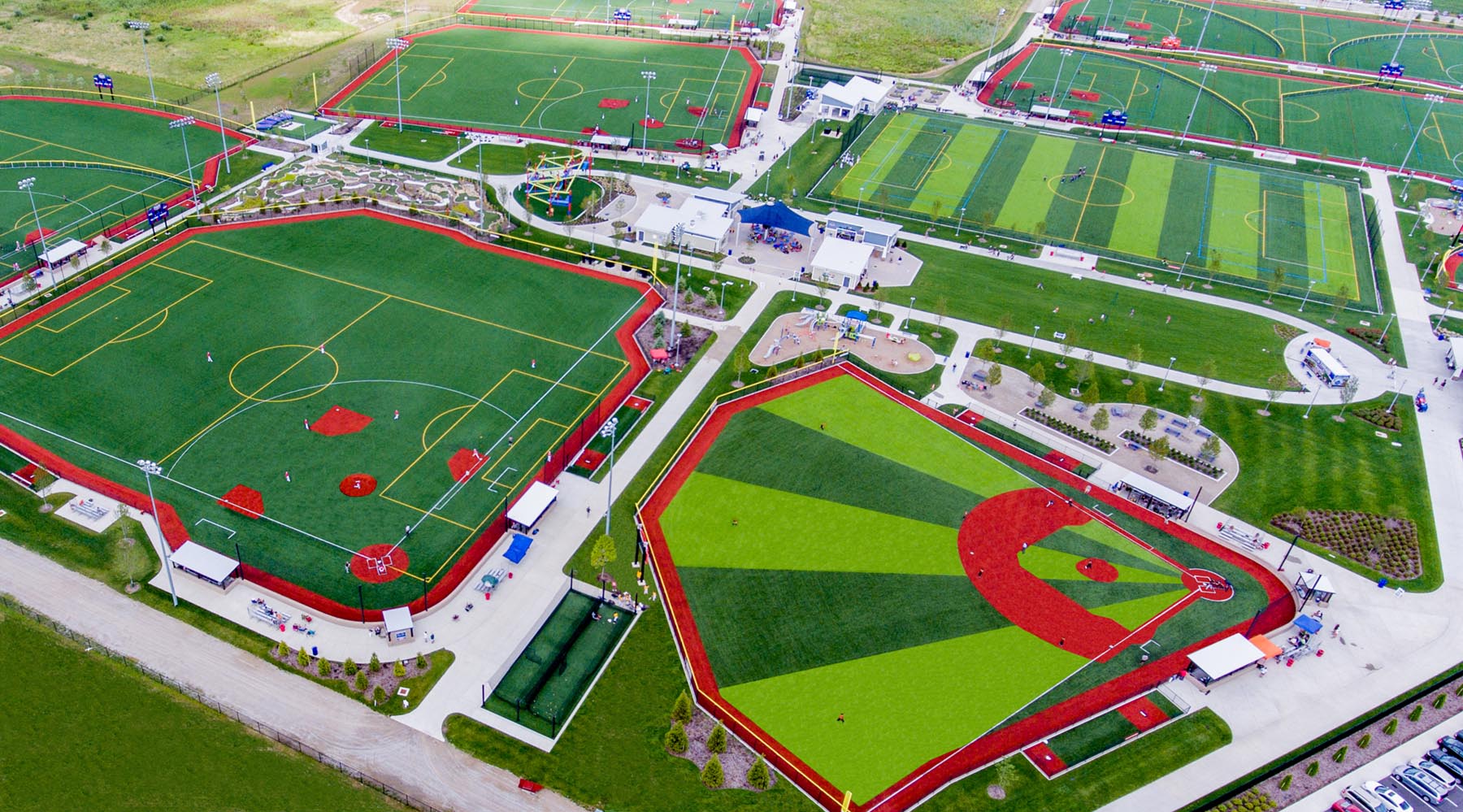
The scope of work on this complex included building two synthetic multipurpose fields and two softball fields. We had to import 125,000 cubic yards of dirt to balance the site and create the subgrade for the playing surfaces. We also created the plateaus between the elevation changes by using modular block walls with a total of 4,000 linear feet at an average height of 6 feet. Also, 3,000 linear feet of 18-inch curb that encircled the fields was installed.
We built two sections of concrete stadium seats with aluminum bleachers attached. All the fencing was installed, including backstops, ball control fencing and dugouts. The site had a 120-car parking lot with lights and all of the fields had 80-foot Musco light poles installed. The site work also included 24,000 square feet of scored concrete sidewalk with tooled edges on all panels. There was an 18-inch seat wall that incorporated the name of the project in the face of the wall. The site had multiple asphalt pathways for walking trails.
The entire site was irrigated, including the fields and landscape areas outside the fields. We encountered basalt rock that had to be blasted in order to install the drain lines and the parking lot. Many of the big rocks were saved to create a natural looking rivulet to handle spring runoff.
FIELDS brought a team approach to the project and suggested several field design changes that made it possible to save the owner more than $500,000 by working closely with our partners – including the owner, D.A. Hogan – and various subcontractors before and during construction.